
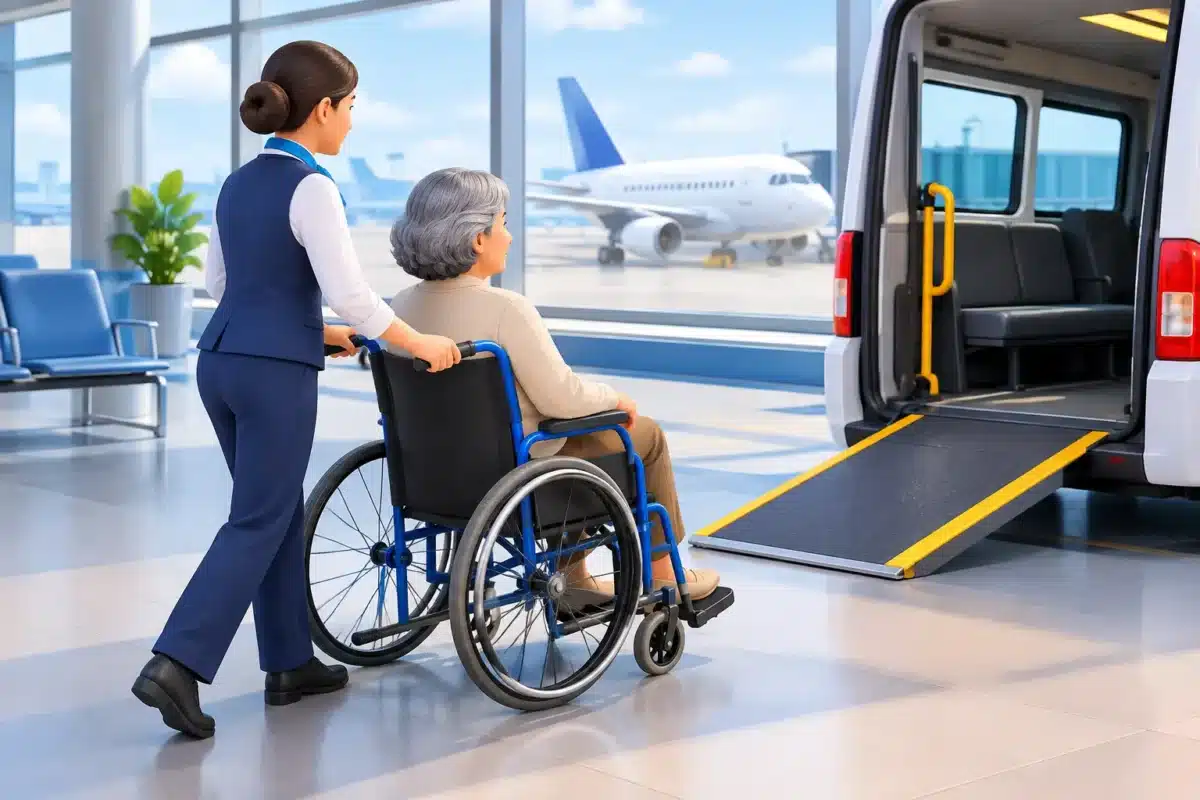
A wheelchair request should never be an afterthought made while rushing through a crowded terminal. Knowing how to arrange airport wheelchair transfer before travel day gives the passenger, family members, and airport staff the time to coordinate properly. It also helps prevent a common misunderstanding: airport wheelchair assistance and accessible ground transportation are separate services, and both may need to be reserved.
For a business traveller recovering from surgery, an older parent flying to visit family, or an international student arriving in Canada for the first time, a clear plan makes the journey calmer from the front door to the gate.
Start with the airline, not the airport
In most cases, the airline arranges wheelchair assistance inside the airport. This service can cover the trip from the check-in area through security and to the departure gate, or from the arriving aircraft to baggage claim and the public pickup area. The precise level of assistance depends on the passenger’s mobility and the airline’s procedures.
Make the request when booking the flight whenever possible. If the ticket has already been purchased, contact the airline or travel agent well before departure and ask for wheelchair assistance to be added to the reservation. Confirm the request again 24 to 48 hours before the flight, particularly during busy travel periods or when an itinerary includes connections.
Be specific about what the passenger can and cannot do. A person who can walk short distances but cannot manage a long terminal may need a different level of support than someone who cannot climb stairs, cannot walk to a seat, or travels with a personal mobility device. Clear information helps the airline assign appropriate assistance rather than making assumptions at the terminal.
How to arrange airport wheelchair transfer for every stage
A complete airport plan has three parts: the ride to the terminal, assistance within the airport, and the ride home or to the final destination. Booking only one part can leave an uncomfortable gap at the most tiring point of the journey.
For departure, arrange your chauffeur service with enough time for check-in, baggage handling, security, and boarding. Tell the transportation provider that the passenger uses a wheelchair or has limited mobility. Include the number of travellers, luggage pieces, whether the wheelchair folds, and whether it is manual, powered, or a mobility scooter. These details affect vehicle selection and loading arrangements.
For arrival, provide the flight number as well as the scheduled arrival time. A professional airport transfer provider can plan around the flight status, but the booking should also include the passenger’s expected meeting point. Airport wheelchair assistance usually ends at a designated public area or curbside location, not necessarily at the vehicle door. Ask the airline where its attendant will bring the passenger after baggage collection so the chauffeur can meet them at the most practical permitted location.
When booking with Airport Global Limo, sharing these mobility requirements in advance allows the team to recommend an appropriate vehicle and build a more comfortable pickup plan. It is far easier to plan the right service before the journey than to try to change vehicles at the terminal.
Confirm what kind of assistance is actually needed
The word “wheelchair” can mean several different things. Some passengers need a chair only for the long walk through the airport. Others use a wheelchair full time and require a vehicle with suitable space, secure loading, or accessibility features. Do not assume that an airport chair will be available for use outside the terminal, or that any large vehicle can safely carry a wheelchair.
Discuss these practical points before reserving transportation:
- Can the passenger transfer independently from a wheelchair into a vehicle seat?
- Does the passenger need a wheelchair-accessible vehicle, a ramp, or a lift?
- Will a companion be travelling to provide personal support?
- Is the wheelchair foldable, and what are its dimensions and weight?
- Is there medical equipment, extra baggage, or a service animal to accommodate?
Airport and chauffeur staff can assist within the scope of their service, but they may not be permitted or trained to provide personal care, lifting, or medical support. If the passenger requires help transferring, medication management, or continuous supervision, travel with an appropriate companion or arrange qualified support. Setting expectations clearly protects the passenger’s comfort and safety.
Allow more time than a standard airport trip
A premium airport ride is most valuable when it removes pressure, not when it creates a tighter schedule. Passengers using wheelchair assistance should plan additional time for check-in, security screening, washroom breaks, boarding, and the handoff between airport personnel and ground transportation.
For flights departing from Toronto Pearson or another busy Canadian airport, arrive earlier than the minimum airline recommendation. The right amount of extra time depends on the airline, terminal, travel season, personal mobility, and whether checked baggage or mobility equipment is involved. International flights and peak holiday departures often warrant a wider margin.
On arrival, patience matters just as much. Deplaning assistance may occur after other passengers leave the aircraft, and baggage delivery can vary. A carefully planned pickup avoids the need for the passenger to wait alone at the curb or move through a busy terminal unnecessarily.
Bring the details that prevent last-minute problems
Keep flight information, airline confirmation numbers, chauffeur booking details, and emergency contacts accessible on a phone and in a printed copy. Battery life, mobile reception, and unfamiliar airport procedures can all become minor obstacles at the wrong moment.
If travelling with a powered wheelchair or scooter, verify battery requirements with the airline well in advance. Airlines may have specific rules for lithium batteries, removable components, and how mobility devices are prepared for carriage. Measure the device and record its weight. This information is useful for both the airline and the ground transportation provider.
It is also wise to label mobility equipment with the passenger’s name and contact number, and to take a quick photo of its condition before checking it. This is not an expectation of a problem. It is simply a sensible record for valuable equipment that is essential to the passenger’s independence.
Coordinate the handoff on arrival
The final handoff is where good planning becomes visible. Before the flight, decide who will communicate with the chauffeur if the passenger cannot easily make calls. This may be a family member, travel coordinator, or companion. Give that person the booking details and make sure they understand the pickup instructions.
Ask the airline about the post-arrival process, especially for passengers who need assistance from the aircraft through customs, baggage claim, and the arrivals level. At Canadian airports, procedures can differ by terminal and by whether the flight is domestic, transborder, or international. The passenger should not be left guessing where assistance ends.
For the ground transfer, confirm the vehicle description, chauffeur contact procedure, and the pickup zone on the day before travel. If flight timing changes, notify the transportation provider as soon as possible. Flight tracking helps, but direct communication is still useful when mobility assistance, checked equipment, or customs delays affect the timing.
A comfortable journey is a coordinated journey
Wheelchair assistance is not only about getting from one point to another. It is about preserving dignity, reducing fatigue, and giving the traveller enough time to move at a comfortable pace. The best arrangement accounts for the full journey – from a reliable vehicle at home, to properly requested airport assistance, to a chauffeur ready when the passenger reaches the arrivals area.
Make the calls early, share the details honestly, and leave room in the schedule. That preparation turns a potentially demanding airport day into a travel experience that feels respectful, organized, and reassuring.


